









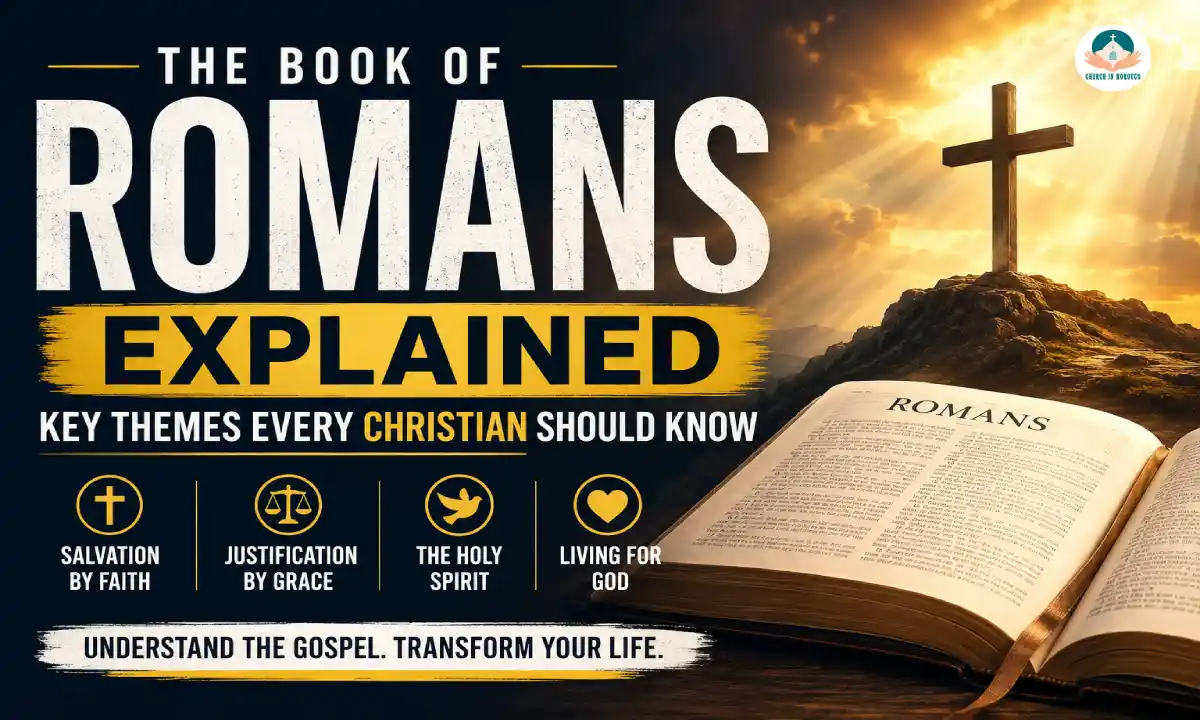
The Book of Romans is one of the most important books in the New Testament for understanding the Christian faith. Written by the Apostle Paul, Romans addresses some of the deepest questions about sin, salvation, justification, faith, grace, the Holy Spirit, God’s promises, and the Christian life.
But The Book of Romans is not simply a theological book. It speaks directly to a question that every human being faces: How can a sinful person stand right before a holy God?
Many people spend their lives trying to prove that they are good enough. We compare ourselves with others, defend our actions, follow religious practices, or try to build a moral record that gives us confidence before God.
Paul presents a radically different answer. The Christian message is not that we can save ourselves by becoming morally perfect. It is that God has provided salvation through Jesus Christ. This is the central message of the Book of Romans.
What Is the Main Message of The Book of Romans?
The main message of Romans is that all people are sinners and that righteousness before God comes through faith in Jesus Christ.
Paul develops this argument carefully throughout the letter.
Human beings cannot establish their own righteousness through religious observance, morality, knowledge, or personal achievement. Both the person who openly rejects God and the religious person who trusts in his own righteousness stand in need of God’s grace.
Paul summarizes the human condition in Romans 3:23:
“For all have sinned and fall short of the glory of God.”
This statement removes every reason for human boasting.
No one can stand before God and claim that personal goodness is enough. No one has a perfect record.
The problem is universal. But Paul does not stop with the problem.
He points to the solution: Jesus Christ and His work on the cross.
Why Did Paul Write the Letter to the Romans?
The Apostle Paul wrote Romans to Christians in Rome during the first century. The letter addresses major theological questions while also dealing with tensions between Jewish and Gentile believers.
Questions about the Law of Moses, identity, faith, and belonging to the people of God were important issues for the early Christian community.
Paul therefore addresses both groups.
He does not allow Jewish believers to boast in possessing the Law, and he does not allow Gentile believers to boast either. The ground is level before God.
The message is clear: salvation is not a reward for belonging to the right social, ethnic, or religious group. It is a gift of God’s grace received through faith in Christ.
This remains one of the central themes of Romans.
Romans 1–3: Why Every Person Needs Salvation
The opening chapters of Romans present a serious picture of humanity.
Paul begins by discussing people who reject the knowledge of God and turn toward created things rather than worshiping the Creator.
He then turns his attention toward those who judge others while believing that they themselves are morally superior.
The argument becomes increasingly clear: no one can claim complete righteousness before God.
- The religious person needs grace.
- The immoral person needs grace.
- The moral person needs grace.
- The educated person needs grace.
- The skeptic needs grace.
- The believer needs grace.
Romans therefore destroy the idea that we can compare ourselves with other people and use that comparison to establish our righteousness before God.
You may be better than another person in a particular area of life, but that does not make you righteous before a holy God.
Paul’s conclusion is direct:
“For all have sinned and fall short of the glory of God.”
This is not simply an accusation. It is a diagnosis.
Before a person can understand the good news of salvation, that person must first understand the seriousness of sin.
What Does Romans Teach About Justification by Faith?
One of the most important teachings in Romans is justification by faith.
Paul explains that sinners can be justified freely by God’s grace through Jesus Christ.
Romans 3:24–25 points to Christ’s redemption and His sacrificial death.
The word “justification” describes a legal declaration. In biblical terms, the sinner who trusts in Christ is declared righteous before God.
This raises an important question:
How can God forgive sinners while remaining just?
The Christian answer is found in the cross.
God does not simply ignore sin.
The cross demonstrates both the seriousness of sin and the depth of God’s grace. Jesus Christ gave Himself for sinners, bearing the judgment associated with sin so that those who trust in Him can receive forgiveness and righteousness.
This is why the cross stands at the center of the Christian gospel.
Is Christian Faith Just Blind Faith?
One common objection to Christianity is that faith means believing something without evidence.
But the Christian concept of faith is not simply a decision to believe something irrational.
Christian faith has an object: Jesus Christ.
The believer trusts in Christ, His death, His resurrection, and God’s promises revealed through Him.
Faith is therefore not confidence in our own moral performance. It is trust in what God has accomplished through Christ.
This distinction is important.
If salvation depended on our ability to become perfect, we would never have certainty. Our confidence would constantly rise and fall according to our performance.
But if salvation rests upon God’s grace and Christ’s finished work, the foundation is outside ourselves.
That is the freedom at the heart of the gospel.
Justification by Faith Does Not Give Christians Permission to Sin
Another important question naturally follows.
If salvation is a free gift and good works do not earn justification, why should Christians live morally?
Could someone simply say, “God forgives me,” and then continue living however they want?
Paul answers this objection directly in Romans 6:1:
“Shall we go on sinning so that grace may increase?”
His answer is unmistakable:
“By no means!”
Grace does not make sin acceptable.
Instead, genuine faith in Christ changes the believer’s relationship with sin.
Paul describes believers as having died to sin and being united with Christ.
The Christian life is therefore not about earning salvation through good works. Good works become the response to salvation already received.
This distinction is essential:
Christians do not obey God in order to purchase His love. They seek to obey God because they have received His grace.
Romans 7: The Christian Struggle With Sin
Romans do not present the Christian life as effortless.
In Romans 7, Paul describes a painful struggle between the desire to do what is good and the presence of sin.
The passage speaks to anyone who has sincerely tried to live according to God’s will and discovered how difficult it can be.
The human heart can desire what is right while still struggling with sinful habits and desires.
Paul eventually cries out:
“What a wretched man I am! Who will rescue me from this body that is subject to death?”
The answer comes immediately:
Jesus Christ.
The Christian does not overcome sin through human strength alone.
This prepares the way for one of the greatest declarations in the entire New Testament.
Romans 8: No Condemnation for Those in Christ
Romans 8 begins with a powerful statement:
“Therefore, there is now no condemnation for those who are in Christ Jesus.”
This verse captures one of the central hopes of the gospel.
The Christian’s relationship with God is not based on constantly trying to prove personal worth.
Those who belong to Christ are no longer under condemnation.
Paul then emphasizes the work of the Holy Spirit.
The Christian life is not merely about trying harder. The Holy Spirit works within believers, changing their desires, strengthening them to live according to God’s will, and reminding them of their relationship with God.
This does not mean Christians never struggle.
It means that the struggle does not have to end in despair.
The believer’s hope is not found in personal perfection but in Christ.
What Do Romans Say About Israel and God’s Promises?
Romans chapters 9–11 raise another difficult question:
If many Jewish people rejected Jesus as the Messiah, did God’s promises to Israel fail?
This question matters because it touches the character of God.
If God could abandon His promises, why should anyone trust His promises?
Paul takes this question seriously.
He examines God’s purposes in Israel, the patriarchs, God’s sovereignty, and the inclusion of the Gentiles.
His conclusion is that God’s Word has not failed.
Paul’s discussion also shows that God’s purposes cannot be reduced to human expectations.
The story of salvation is ultimately about God’s grace and His sovereign purposes.
At the end of this section, Paul responds not merely with another argument but with worship:
“Oh, the depth of the riches of the wisdom and knowledge of God!”
Romans therefore moved from theology to worship. Understanding who God is should produce humility.
Romans 12: From Theology to Christian Living
Romans do not end with theological ideas.
The truths Paul has explained lead directly to practical Christian living.
Romans 12:1 says:
“Therefore, I urge you, brothers and sisters, in view of God’s mercy, to offer your bodies as a living sacrifice.”
The word “therefore” is important.
Paul has spent the earlier chapters explaining God’s mercy, human sin, justification, grace, Christ’s work, the Holy Spirit, and God’s faithfulness.
Now he asks:
How should we respond?
The answer is with our lives.
Christian worship is not limited to words, songs, or religious ceremonies. The believer is called to offer his or her entire life to God.
Paul continues by calling Christians to renew their minds and reject the patterns of this world.
The gospel should affect how we think, speak, work, forgive, serve, and treat other people.
What Does the Book of Romans Teach About Good Works?
Romans make an important distinction between earning salvation and living as someone who has received salvation.
Good works cannot become a substitute for God’s grace.
At the same time, grace does not produce a careless life.
A transformed relationship with God should produce transformed behavior.
Christians are called to love others, serve those in need, pursue peace, live in unity, and respond to evil with good.
These actions are not the price of salvation.
They are the response to God’s mercy.
This is why Romans present Christian ethics as flowing from the gospel rather than replacing it.
Why Is the Book of Romans Important for Christians Today?
The Book of Romans remains deeply relevant because the human problems it addresses have not disappeared.
People still struggle with guilt.
People still compare themselves with others.
People still search for acceptance.
People still ask whether God can forgive them.
People still struggle with sin.
People still question God’s justice.
And people still ask whether God’s promises can be trusted.
Romans speaks to all of these questions.
Its message is both serious and hopeful.
Humanity’s problem is deeper than bad behavior. Our fundamental problem is sin and separation from God.
But God’s answer is greater than our failure.
- Grace.
- Christ.
- The cross.
- Faith.
- The Holy Spirit.
- A new life.
Romans and the Christian Understanding of Salvation
The message of Romans can be summarized through several connected truths:
- All people have sinned.
- Human morality cannot provide perfect righteousness before God.
- Jesus Christ provides redemption.
- Justification is received through faith.
- Salvation is a gift of God’s grace.
- Grace does not give permission to continue in sin.
- The Holy Spirit works in the life of the believer.
- God remains faithful to His purposes and promises.
- God’s mercy should produce a life of worship and service.
Together, these themes give us a clear picture of Paul’s message.
Romans Points Us to the Cross
The Book of Romans begins by exposing the depth of humanity’s problem, but it does not leave us there.
The same letter that speaks about sin speaks about grace.
The same letter that exposes human guilt speaks about justification.
The same letter that describes the struggle with sin announces freedom from condemnation.
The same letter that asks difficult questions about God’s promises ends in worship.
And all of this points us back to Jesus Christ.
The cross is where God’s justice and mercy meet.
Christianity does not teach that human beings can save themselves by keeping a perfect moral record. It teaches that God has acted in Christ to provide salvation for sinners.
That is why the message of Romans continues to matter.
How Should You Read the Book of Romans?
If you are a Christian, Romans deserves careful and repeated reading.
Do not read it only as a collection of isolated verses.
Follow Paul’s argument.
Read Romans 1–3 and consider the human problem of sin.
Read Romans 3–5 and examine justification, faith, grace, and Christ’s work.
Read Romans 6–8 and consider the Christian’s relationship to sin, the struggle with the flesh, the work of the Holy Spirit, and freedom from condemnation.
Read Romans 9–11 and think carefully about God’s faithfulness and His purposes.
Then read Romans 12 onward and see how Christian theology becomes Christian living.
Romans does not allow us to separate what we believe from how we live.
A Message for Christians and Those Searching for Truth
For Christians, the Book of Romans is a call to deeper faith.
Do not build your confidence on your own performance.
Your hope is in Christ.
When you fail, remember grace.
When you struggle with sin, remember that you are called to a new life.
When doubts arise, return to the gospel.
And when you see God’s mercy clearly, let that mercy shape the way you live.
For those who are not Christians but are asking honest questions, Romans is worth reading for yourself.
Read it critically.
Read it carefully.
Ask what Paul is actually claiming.
Ask whether the Christian explanation of sin, justice, mercy, and salvation makes sense of the human condition.
The Book of Romans does not merely ask you to become a better person.
It asks you to consider Jesus Christ.
Conclusion: The Central Message of Romans
The Book of Romans is a powerful explanation of the Christian gospel.
It begins with humanity’s need.
It explains the problem of sin.
It shows why self-righteousness cannot save us.
It presents justification through faith in Jesus Christ.
It explains the meaning of grace.
It addresses the struggle with sin.
It announces that there is no condemnation for those who are in Christ Jesus.
It explains the work of the Holy Spirit.
It addresses God’s faithfulness to His promises.
And finally, it calls believers to offer their lives to God.
The message is simple at its center:
We cannot save ourselves. God has provided salvation through Jesus Christ.
Our righteousness is not something we manufacture through religious performance. It is found in Christ.
And the response to such grace is not continued rebellion, but a transformed life of worship, love, service, and obedience.
If you want to understand the foundations of Christian salvation, justification by faith, grace, sin, and life in Christ, the Book of Romans is one of the most important places to begin.
Read it.
Think about it.
Test its claims.
And most importantly, consider what it says about Jesus Christ.
FAQ: The Book of Romans Explained
What is the main message of the Book of Romans?
The main message of Romans is that all people are sinners and that righteousness and salvation are provided by God’s grace through faith in Jesus Christ.
What does Romans teach about salvation?
Romans teaches that salvation is not something people can earn through religious works or personal morality. Salvation comes through God’s grace and faith in Jesus Christ.
What is justification by faith in Romans?
Justification by faith means that God declares sinners righteous through faith in Jesus Christ rather than because of their own works or moral achievements.
What does Romans 3:23 mean?
Romans 3:23 teaches that every human being has sinned and falls short of God’s glory. It shows why everyone needs God’s grace and salvation.
Does justification by faith mean Christians can continue sinning?
No. Romans 6 directly rejects the idea that God’s grace gives Christians permission to continue living in sin. Grace leads to a new life in Christ.
What does Romans 7 teach about the struggle with sin?
Romans 7 describes the conflict between the desire to do what is right and the power of sin. It shows humanity’s need for Jesus Christ rather than dependence on human strength.
What does Romans 8 mean by “no condemnation”?
Romans 8:1 teaches that those who are in Christ Jesus are no longer under condemnation. Their standing before God rests on Christ rather than their own perfect performance.
What does the Book of Romans teach about the Holy Spirit?
Romans teaches that the Holy Spirit works in believers, helping them live according to God’s will and giving them hope and assurance in Christ.