











If you were to walk the dusty roads of first-century Judea and ask a passerby where to find “Jesus Christ,” you would be met with bewildered stares. The crowds pressing in to touch the carpenter from Nazareth did not know that English name. They were seeking, listening to, and worshiping Yeshua HaMashiach.
It is a profound and tragic reality of human nature that we instinctively attempt to remake our heroes in our own image. For centuries, the Western church has too often fallen prey to this exact temptation. They have inadvertently severed our Savior from the soil of His birth, presenting a culturally sanitized, historically detached figure that is easier to manage but profoundly less accurate to the biblical witness.
This intellectual isolation and the stubborn refusal to engage with the first-century Jewish world of the Incarnation has left many believers with a historical amnesia that inherently weakens their faith. We read the Scriptures through myopic, modern lenses, missing the breathtaking depth of the original text. We are forced to ask a difficult question: Are we worshiping the Christ of history, or a savior of our own cultural making?
Uncovering the true meaning of Yeshua HaMashiach is not an exercise in academic elitism, nor is it a pedantic linguistic game. Rather, it is a vital, pastoral journey to understand the Savior in the exact historical, cultural, and linguistic context that God sovereignly chose for His arrival. Let us systematically examine the meaning of this sacred name, dismantle the confusion that surrounds it, and discover why this historical reality will fundamentally enrich your Christian faith.
What Does Yeshua HaMashiach Mean?
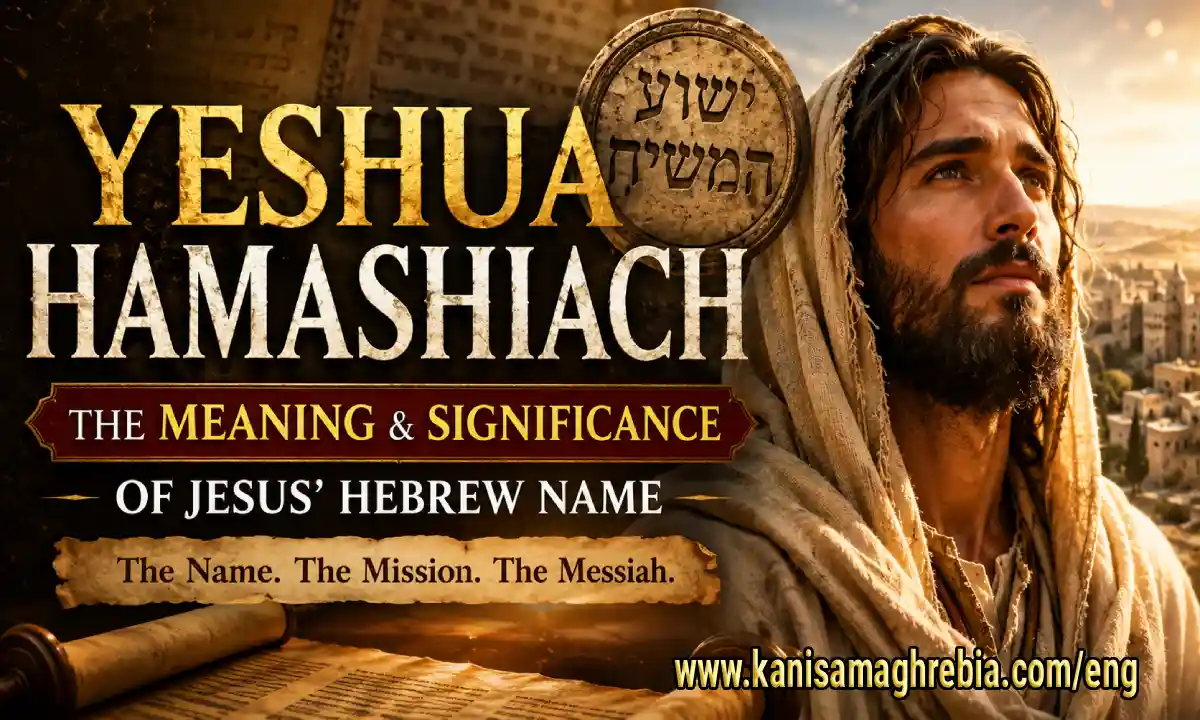
“Yeshua HaMashiach” is the original Hebrew and Aramaic title for Jesus Christ. Yeshua means “The Lord is Salvation” or simply “Salvation,” serving as the historical name of Jesus. HaMashiach translates to “The Anointed One,” denoting His prophesied title as the ultimate Prophet, Priest, and King.
What: Unpacking the Name Yeshua
To understand a name is to understand a destiny. In the ancient Near East, a name was never merely a phonetic identifier; it was a prophetic declaration of character, purpose, and identity. When we ask about the meaning of Yeshua HaMashiach, we must begin with the first word, the name itself: Yeshua.
Yeshua is a Hebrew name that was highly common in first-century Judea. Linguistically, it is a shortened, later adaptation of the older Hebrew name Yehoshua (Joshua). At its etymological root lies the Hebrew verb yasha, which means to deliver, to rescue, or to save. Therefore, Yehoshua and its everyday, conversational form, Yeshua literally translates to “Yahweh is Salvation” or “The Lord Saves.”
This linguistic reality unlocks one of the most beautiful and easily missed theological wordplays in the entire New Testament. When the angel appears to Joseph in Matthew 1:21, the English translation reads: “She will bear a son, and you shall call his name Jesus, for he will save his people from their sins.”
In English, the sentence states a fact. In Greek, it does the same. But in the original Hebrew mindset in which this angelic declaration was communicated, it is a profound, poetic revelation. The angel is essentially saying: “You shall call his name Salvation (Yeshua), for he will save (yasha) his people.” The name itself is the very definition of His earthly mission. To strip Him of this Hebrew reality is to miss the divine poetry of His arrival. Every time Mary or Joseph called the child in for dinner, every time a blind man cried out to Him on the road to Jericho, they were literally declaring, “Salvation!”
How: Understanding the Title HaMashiach
How did this man named Salvation operate in the world? We find the answer in His title. We must emphatically correct a widespread misunderstanding in the modern church: “Christ” is not Jesus’ last name.
When we read “Jesus Christ,” our modern sensibilities assume “Jesus” is His given name and “Christ” is His surname, much like “John Smith.” This is a fundamental theological error. “Christ” is a title, derived from the Greek Christos, which is a direct translation of the Hebrew word Mashiach (Messiah). The prefix Ha simply means “The.” Therefore, Yeshua HaMashiach translates to “Jesus, the Messiah,” or “Jesus, the Anointed One.”
How did the concept of anointing function in the Old Testament? In ancient Israel, anointing with oil was a sacred, highly regulated ritual. It was the physical mechanism by which God consecrated a person for a specific, holy office. The oil symbolized the pouring out of the Holy Spirit, equipping the individual for divine service.
There were only three offices in ancient Israel that required anointing:
- The Prophet: Anointed to speak the words of God to the people (1 Kings 19:16).
- The Priest: Anointed to represent the people before God, offering sacrifices for sin (Exodus 28:41).
- The King: Anointed to rule, protect, and shepherd God’s people (1 Samuel 16:13).
In the history of Israel, no single individual ever held all three offices simultaneously. A king could not be a priest (King Uzziah was struck with leprosy for attempting to offer incense in the temple). A priest was not a king. But the promise of HaMashiach the ultimate Anointed One was the promise of one who would perfectly unify all three offices.
Yeshua is the Prophet who speaks the ultimate truth of God. He is the Priest who offers the ultimate sacrifice Himself for the sins of the world. And He is the King who will reign in ultimate righteousness forever. When we declare Him HaMashiach, we are acknowledging how He systematically fulfills every requirement of the Old Covenant.

Who: The Linguistic Journey from Yeshua to Jesus
If His name was Yeshua, who decided to call Him Jesus? Here we must confront a deeply frustrating, pseudo-intellectual movement that frequently circulates in our modern era. There are fringe groups and online provocateurs who weaponize historical ignorance, claiming that the name “Jesus” is a pagan corruption, a sinister plot by the early church to erase His Jewishness, or even a linguistic derivative of the Greek god Zeus.
This is not only historical nonsense; it is a spiritual distraction designed to sow doubt. We must dismantle this objection with methodical, historical precision. The transition from Yeshua to Jesus is not a conspiracy; it is a perfectly normal, trackable process of transliteration (moving a word from one alphabet to another based on sound).
- From Hebrew to Greek (Iesous): When the New Testament was written in Greek, the writers faced a linguistic hurdle. The Greek alphabet does not have a “sh” sound, and Greek grammar requires masculine names to end in an “s” to function correctly in sentences. Therefore, the Hebrew Yeshua was transliterated as Iesous (ee-ay-SOOS). We know this was standard practice because Jewish scholars had already done the exact same thing 200 years earlier when they translated the Old Testament into Greek (the Septuagint), calling Joshua Iesous.
- From Greek to Latin (Iesus): As the Gospel spread into the Roman Empire, the Greek Iesous was transliterated into Latin as Iesus.
- From Latin to English (Jesus): For centuries, English did not possess the letter “J”. Words began with an “I” that was sometimes pronounced with a “Y” sound. In the 16th and 17th centuries, the letter “J” was developed in the English language to represent the harder consonant sound. Thus, Iesus naturally evolved in spelling and pronunciation to Jesus.
Is the name Jesus a pagan invention? Absolutely not. It is the phonetic legacy of the Gospel expanding across the globe, crossing linguistic barriers just as Christ commanded. We do not need to abandon the English name “Jesus,” but we must respect the linguistic journey that brought it to our lips.
Where and When: The First-Century Context of the Incarnation
Why does the specific “where” and “when” matter? The incarnation of the Son of God did not happen in a vacuum. God did not drop a culturally neutral Savior into an ambiguous point in time. Galatians 4:4 reminds us, “But when the fullness of time had come, God sent forth his Son, born of woman, born under the law.”
To understand Yeshua HaMashiach is to embrace the Jewish roots of Christianity. God deliberately chose first-century Judea. He chose a Jewish mother, a Jewish culture, and the Hebrew and Aramaic languages to communicate the definitive revelation of Himself to humanity.
Throughout church history, there has been a tragic, sinful current of anti-Semitism that sought to de-Judaize Jesus. Theologians and leaders, infected by prejudice, tried to sever Christianity from its Hebrew roots, resulting in a distorted theology that culminated in unspeakable historical atrocities against the Jewish people. This intellectual and moral backwardness must be aggressively opposed by the modern believer.
When we say Yeshua HaMashiach, we are actively fighting against the historical amnesia of the church. We are remembering that our Savior read from the Torah, worshipped in the synagogue, celebrated the Passover, and debated the nuances of Jewish law. To ignore His Jewishness is to ignore the very theological framework God designed to explain the Gospel. You cannot understand the Lamb of God without understanding the Jewish Passover. You cannot understand the Great High Priest without understanding the Levitical system. The “Where” and “When” provide the indispensable vocabulary for the “Why” of our salvation.
Why It Matters Today: The Meaning of Yeshua HaMashiach
Why are we taking this methodical journey into linguistics and history? Are we merely trying to fill our heads with academic trivia? God forbid. Theology that does not lead to doxology to worship is a dead religion.
Understanding Yeshua HaMashiach matters profoundly because it anchors our faith in reality. We live in an age of theological drift, where spiritual seekers want a personalized, subjective Jesus who demands nothing and simply affirms their lifestyle. But when you anchor yourself to the historical Yeshua the Jewish Messiah who fulfilled centuries of rigorous, blood-bought prophecy you are confronted with a King who possesses absolute authority over your life.
Does God ignore our prayers when we pray in the name of “Jesus”? Certainly not. The Lord looks upon the heart, and He knows exactly who we are crying out to. Grace is not bound by our ability to perfectly pronounce ancient Hebrew consonants. We need not fall into the legalistic trap of believing that “Yeshua” is a magical incantation required for God to hear us.
But does knowing His original name enrich our faith? Does it expand our awe? Unquestionably. When you know Him as Yeshua HaMashiach, you are connected to the grand, sweeping narrative of redemptive history. You realize that your salvation was not a divine afterthought, but a meticulously planned rescue mission woven into the fabric of the Hebrew language itself. Knowing His original name deepens our intimacy with Him, much like learning the childhood history of a spouse deepens a marriage. It brings color, context, and vivid life to the Savior we love.
Frequently Asked Questions: The Meaning of Yeshua HaMashiach
How do you pronounce Yeshua HaMashiach? It is pronounced yeh-SHOO-ah ha-mah-SHEE-akh. The “ch” in Mashiach is not a hard “K” sound, nor a soft “ch” like in “chair.” It is a guttural sound made in the back of the throat, similar to the “ch” in the Scottish word “loch” or the German name “Bach.”
Did Jesus’ disciples call Him Jesus or Yeshua? During His earthly ministry, His mother, His disciples, and the crowds in Galilee and Judea would have called Him Yeshua. They spoke Aramaic and Hebrew. The name “Jesus” (Iesous) was used by Greek speakers and became prominent as the New Testament was recorded in Greek.
Is it wrong to pray using the name Jesus? No, it is not wrong. The New Testament was divinely inspired and written in Greek, utilizing the transliterated name Iesous. The power of Christ’s name lies in His authority, His identity, and His finished work on the cross, not in the phonetic sounds of a specific language. Praying to “Jesus” is entirely biblical and eternally effective.
Where does the title “HaMashiach” appear in the Old Testament? While the exact phrase “Yeshua HaMashiach” is a New Testament fulfillment, the concept and word Mashiach (Messiah) appears dozens of times in the Old Testament. One prominent prophetic example is found in Daniel 9:25, which speaks of the coming of “an anointed one, a prince” (Mashiach Nagid) who will bring salvation.
Conclusion: Yeshua HaMashiachThe Name Above All Names
We have methodically traced the meaning, the history, and the theology of the name Yeshua HaMashiach. We have seen how Yeshua embodies the very salvation He brought, and how HaMashiach fulfills every prophetic office of ancient Israel. We have dismantled the cynical myths surrounding the transliteration of His name and reclaimed the vital importance of His first-century Jewish context.
But in the end, academic understanding must yield to bended knees. The Apostle Paul, writing in Greek to a church in a Roman colony, declared that God has highly exalted Him and bestowed on Him “the name that is above every name, so that at the name of Jesus every knee should bow, in heaven and on earth and under the earth” (Philippians 2:9-10).
Whether you cry out to Him in English, Spanish, Greek, or His native Hebrew, the reality of His identity remains unshaken. He is the Prophet who guides us, the Priest who bled for us, and the King who is returning for us. Let us hold fiercely to the historical truth of Yeshua HaMashiach, allowing the richness of His Jewish roots to drive us deeper into a vibrant, unshakable faith in the Lord who saves.