









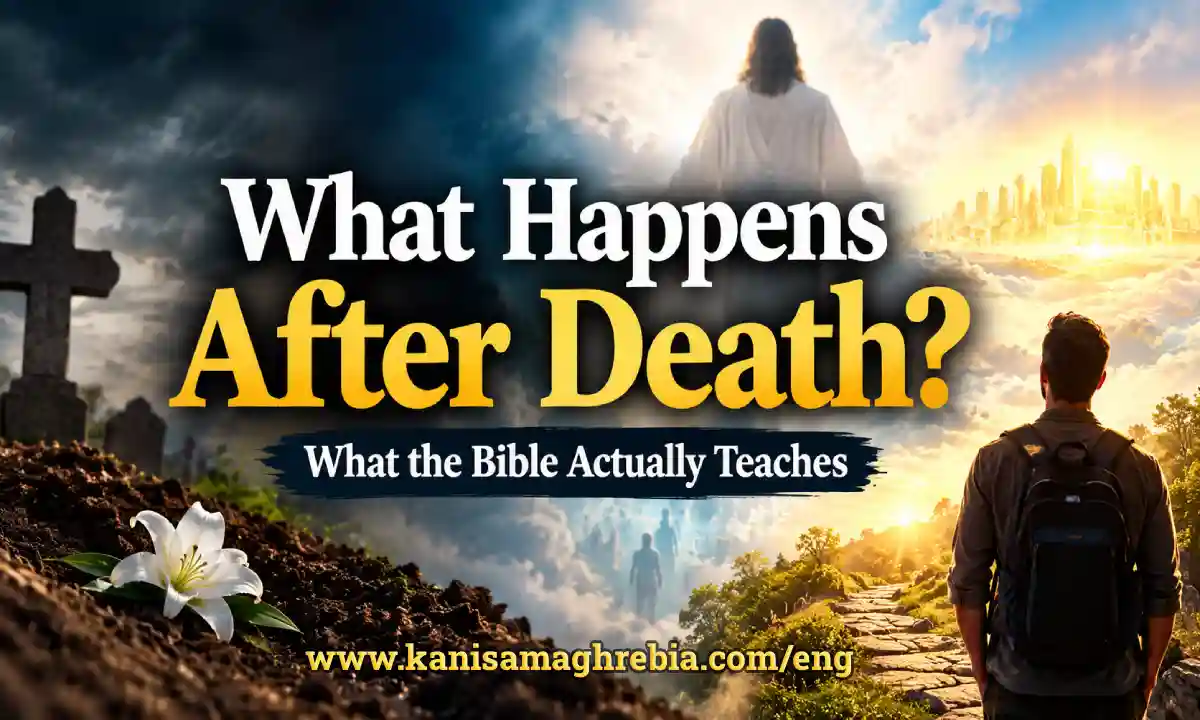
Every human being will face the question of What Happens After Death, and almost no one faces it without wondering what lies beyond. For some people it arrives at a graveside, when a casket is lowered and the mind refuses to accept that someone so present is simply gone. For others it comes in a quiet hour at night, when the fear of ending takes shape. Whatever the occasion, the question is serious, and it deserves a serious answer.
Here is the short answer. According to the Bible, death is not the end of a person. Believers are with Christ after they die, awaiting the resurrection of the body when Jesus returns. Then all people will stand before God in judgment, and those who belong to Christ will live forever in a renewed creation. Christians have held this outline for two thousand years. They have disagreed about one part of it: what the time between death and resurrection is like.
This article follows the Bible’s own order. It begins with what Scripture says death is, then asks what happens at the moment of death, why Christians differ about the interval that follows, what the Bible means by “soul,” and why resurrection, not escape, sits at the center of Christian hope. It then turns to judgment, the new creation, near-death experiences, and the comfort Scripture offers to those who grieve.
Death in the Bible: An Enemy, Not a Friend
The Bible does not treat death as a neutral event. Its opening chapters present death as something that entered a good world through disobedience. God formed the first man “of dust from the ground and breathed into his nostrils the breath of life, and the man became a living creature” (Genesis 2:7). A human being, in this picture, is dust animated by God’s breath, not a spirit trapped in a body. After the fall, God told Adam, “you are dust, and to dust you shall return” (Genesis 3:19). Ecclesiastes describes the same unraveling: “the dust returns to the earth as it was, and the spirit returns to God who gave it” (Ecclesiastes 12:7).
Paul explains the larger story: “just as sin came into the world through one man, and death through sin, and so death spread to all men because all sinned” (Romans 5:12). Because death is a consequence of sin, Scripture never romanticizes it. Paul calls it “the last enemy to be destroyed” (1 Corinthians 15:26). Jesus himself wept at the tomb of Lazarus (John 11:35), even though he knew he was about to raise him.
This matters for everything that follows. Christianity does not say that death is an illusion, or a gentle doorway that leads everyone to the same place. It says that death is real, that it is an enemy, and that Christ has met it and defeated it. In Paul’s words, Christ Jesus “abolished death and brought life and immortality to light through the gospel” (2 Timothy 1:10). Christian hope begins by being honest about how bad death is.
What Happens at the Moment of Death?
The Bible gives few details, but it gives several clear signals. First, death is a boundary. Hebrews 9:27 says, “it is appointed for man to die once, and after that comes judgment.” The verse does not describe timing or mechanism, but it does rule out a second round of earthly lives. That is one reason Christians have historically rejected reincarnation.
Second, Jesus speaks of conscious existence beyond death. To the criminal crucified beside him he said, “Truly, I say to you, today you will be with me in Paradise” (Luke 23:43). “Paradise” was a word, borrowed from Persian, for a garden, and Jewish writers used it for the place of the righteous after death. When the Sadducees denied the resurrection, Jesus answered that God “is not God of the dead, but of the living, for all live to him” (Luke 20:38). In the story of the rich man and Lazarus (Luke 16:19–31), both men are aware after death, one comforted and the other in torment. Interpreters debate how literally to read the details of that story, since Jesus tells it in a teaching setting, but it assumes continued existence and a reversal that cannot be undone.
Third, the Old Testament speaks of the dead in terms of Sheol, the Hebrew word for the realm of the dead, and the New Testament uses Hades, its Greek counterpart. Neither word is a synonym for hell. They describe the condition of the dead in general, and the Old Testament says relatively little about it. Still, believers in the Old Testament clung to hope that God would not abandon them to it (Psalm 16:10; Psalm 73:24), and Daniel 12:2 speaks plainly of awakening. The fuller light came with Christ, which is why Paul says he “brought life and immortality to light.”
Are Believers With Christ Right Away?
This is the question on which careful, faithful Christians disagree, so it is worth setting out each view fairly. Theologians call the time between a person’s death and the resurrection the “intermediate state.”
The case for conscious fellowship with Christ
Most Christians throughout history, including Catholic, Orthodox, and most Protestant traditions, have held that believers who die enter Christ’s presence at once and are conscious there. The case rests on several texts. Jesus told the thief, “today.” Paul writes that to be “away from the body” is to be “at home with the Lord” (2 Corinthians 5:8), and that his desire is “to depart and be with Christ, for that is far better” (Philippians 1:23). Far better than what? Then continued life, which suggests that being with Christ is a richer experience than earthly life, not a blank. In Revelation 6:9–10, John sees the souls of martyrs beneath the heavenly altar crying out to God, which implies awareness.
John Calvin wrote a treatise, Psychopannychia, against the idea that souls sleep until the resurrection, and the Westminster Confession of Faith (chapter 32) teaches that the souls of believers are received into God’s presence while they await the redemption of their bodies.
The case for “sleep”
Other Christians read the evidence differently. This view has been held by some Anabaptists and by Seventh-day Adventists, and Martin Luther, in some of his writings, described the death of believers as a deep, peaceful sleep. Its supporters note that the New Testament often calls death “sleep.” Paul writes about “those who are asleep” (1 Thessalonians 4:13) and calls Christ “the firstfruits of those who have fallen asleep” (1 Corinthians 15:20). Ecclesiastes 9:5 says that “the dead know nothing,” and Daniel 12:2 describes the dead as those who “sleep in the dust of the earth” and then “awake.” When Paul comforts grieving Thessalonians, he points them to Christ’s return and the resurrection, not to the soul’s present bliss. On this reading, the dead experience no gap at all. The next thing they know is the resurrection.
Defenders of conscious fellowship reply that “sleep” is a description of how death looks from the outside. Stephen “fell asleep” (Acts 7:60) just after praying, “Lord Jesus, receive my spirit” (Acts 7:59). They also point out that Ecclesiastes speaks from the viewpoint of life “under the sun,” where the observer sees only what is visible.
A middle path
The Anglican New Testament scholar N. T. Wright, in Surprised by Hope, argues that the New Testament’s main hope is bodily resurrection, not the soul’s survival. He holds that believers who die are with Christ in a state of rest and refreshment, but he treats that interim as a secondary matter and cautions against detailed speculation. Calvin gave a similar warning, saying it is neither lawful nor useful to inquire too curiously into the soul’s intermediate state. Reviewers have noted that Wright’s own descriptions of this state remain tentative.
What can be said with confidence
Several things hold under every view. Believers who die are not lost, forgotten, or separated from Christ. Resurrection, not the intermediate state, is the decisive event. And Christians who disagree on this question have long confessed the same faith in the same Lord. For what it is worth, many interpreters find 2 Corinthians 5:8 and Philippians 1:23 hard to square with simple unconsciousness, though the sleep language of Scripture deserves to be taken seriously too. Honest readers will hold their conclusion with humility.
What Is the Soul, and Does It Survive Death?
Many people assume the Bible teaches the Greek idea of an immortal soul trapped inside a body and released at death. The Bible’s picture is more unified. The Hebrew word nephesh often means a whole living person or a life itself, and the Greek psyche is used similarly. The ESV’s phrase “living creature” in Genesis 2:7 translates nephesh.
Plato taught that the soul is naturally immortal and the body a prison. Scripture says instead that God alone “has immortality” (1 Timothy 6:16) and that eternal life is his gift. Yet Scripture also distinguishes something that continues beyond bodily death. Jesus tells his disciples not to fear “those who kill the body but cannot kill the soul” (Matthew 10:28), and Paul can speak of being “away from the body.”
So the Christian view is neither Platonic nor materialist. A human person is a unity of body and soul. Death tears that unity apart, which is why it is an enemy, and the hope is the restoration of the whole person, not the rescue of a part. Scholars still debate how much particular verses imply about separate existence, and an honest reader should say so.
The Resurrection: The Real Christian Hope
Paul’s longest treatment of the subject is 1 Corinthians 15, and he builds everything on one event: Christ’s resurrection. If Christ has not been raised, he says, faith is futile. But “in fact Christ has been raised from the dead, the firstfruits of those who have fallen asleep” (1 Corinthians 15:20). The word “firstfruits” means the first part of a harvest, with the rest to follow.
The risen Jesus was not a ghost. He invited his disciples to touch him and ate broiled fish in front of them (Luke 24:39–43). Yet his body was also transformed, and Paul says that what is sown perishable is raised imperishable (1 Corinthians 15:42–44). Philippians 3:20–21 promises that Christ “will transform our lowly body to be like his glorious body,” and Jesus himself said that all who are in the tombs will hear his voice and come out (John 5:28–29).
This is why many scholars stress that “going to heaven when you die” is, in the New Testament, at best a first stage. The goal is resurrection life in a renewed world.
A skeptic will say that this is wishful thinking. The reply Christianity gives is that its hope does not rest on a feeling but on a claimed event. Paul lists people who saw the risen Jesus, including more than five hundred at one time, “most of whom are still alive” when he wrote (1 Corinthians 15:3–8). He wrote roughly two decades after the crucifixion, and he passed on a summary that he says he himself received. Skeptics offer alternatives: hallucination, legend, or deliberate deception. Each has to explain why the earliest followers of Jesus were so convinced, why the tomb was empty, and why a movement of persecuted people grew from it. This article cannot settle that debate, but it is the right place to press, because Christian hope about death is only as strong as the resurrection of Jesus.
Judgment and Final Destiny
The Bible teaches that death is followed by judgment (Hebrews 9:27) and that every person will be accountable to God (2 Corinthians 5:10). This is hard to hear, but it is also a form of hope. A world in which murderers, abusers, and tyrants simply escape would not be a world in which God is good. Judgment means that wrongs are named and put right. Jesus himself describes it in Matthew 25:31–46, and John sees it in Revelation 20:11–15.
For those in Christ, the message is different. “There is therefore now no condemnation for those who are in Christ Jesus” (Romans 8:1). Salvation is “by grace through faith,” not earned (Ephesians 2:8–9). Judgment is not a test that believers must pass in order to be accepted. It is the public confirmation of what Christ has done.
The Bible also speaks of a final separation, and here Christians hold three main views. The traditional view holds that the lost experience eternal conscious punishment, pointing to Matthew 25:46 (“these will go away into eternal punishment, but the righteous into eternal life”) and Revelation 14:11. A second view, conditional immortality or annihilationism, holds that the wicked will ultimately be destroyed, pointing to Matthew 10:28 and to 2 Thessalonians 1:9, which speaks of “eternal destruction.” Some evangelical scholars hold this view, though most churches have rejected it. A third view, a hopeful universalism, argues that God will eventually restore all, citing 1 Timothy 2:4 and Colossians 1:20. Most Christian traditions have rejected it as going beyond what Scripture says.
What every view has to face is the seriousness with which Jesus spoke of these things, and the equal seriousness with which Scripture says that God “desires all people to be saved” (1 Timothy 2:4) and is “not wishing that any should perish” (2 Peter 3:9). Those two truths belong together.
The New Creation: Where This Story Ends
The Bible’s story does not end with souls floating in the clouds. It ends with a renewed world. John writes, “Then I saw a new heaven and a new earth” and hears a voice say, “the dwelling place of God is with man” (Revelation 21:1–3). God “will wipe away every tear from their eyes, and death shall be no more, neither shall there be mourning, nor crying, nor pain anymore, for the former things have passed away” (Revelation 21:4).
The prophets painted the same picture. Isaiah 65:17–25 describes people building houses, planting vineyards, and enjoying the fruit of their work. Paul says that creation itself groans, waiting to be set free (Romans 8:19–21). Scripture does not give a full catalog of what that life will be like, and Paul admits that no eye has seen it (1 Corinthians 2:9). But it is consistently physical, communal, and centered on God’s presence. It also helps to separate terms: people often say “heaven” for both the present state of the departed and the final new creation, and the two are not the same.
Do Near-Death Experiences Prove What Happens After Death?
Many people report vivid experiences when they come close to dying: light, peace, a sense of presence. Some are sincere and moving. Skeptics point to explanations such as oxygen deprivation, medication, and stressed brain activity, and the scientific debate is unsettled.
Christians have good reason for caution. Scripture, not experience, is the standard for belief, and these accounts differ widely across cultures and religions, so they cannot decide between competing claims. Even Paul, who described being caught up to the third heaven, said he heard things “that cannot be told, which man may not utter” (2 Corinthians 12:4). Wright has warned Christians against building their beliefs about the afterlife on such testimony. None of this means dismissing people who have had these experiences. It means holding them lightly and resting hope on what God has promised.
Comfort for the Grieving and the Afraid
If you have lost someone, Paul’s words to the Thessalonians were written for you: “we do not want you to be uninformed, brothers, about those who are asleep, that you may not grieve as others do who have no hope” (1 Thessalonians 4:13). Notice that he does not tell them not to grieve. He tells them not to grieve as those who have no hope. Jesus wept at a grave. Grief is not a failure of faith.
If you are afraid of your own death, remember that Christ shared in our humanity “that through death he might destroy the one who has the power of death” and free those who were held in lifelong slavery by the fear of it (Hebrews 2:14–15). His promise to Martha still stands: “I am the resurrection and the life. Whoever believes in me, though he die, yet shall he live” (John 11:25).
That promise does not depend on how much you know about the intermediate state. Whichever view is right, the believer who dies is in the hands of the one who conquered death. And if you are unsure where you stand with God, the Bible’s invitation is simple: turn to Christ, trust him, and ask him for the life he promises.
Frequently Asked Questions: What Happens After Death?
Is purgatory in the Bible?
The Catholic Church teaches purgatory as a purification after death for those who die in God’s grace (Catechism of the Catholic Church, §§1030–1032), pointing to passages such as 1 Corinthians 3:15 and 2 Maccabees 12:43–45. Protestants do not accept 2 Maccabees as Scripture and reject purgatory as inconsistent with the completeness of Christ’s work (Romans 8:1; Hebrews 10:14). Eastern Orthodox churches pray for the dead but do not hold the Latin doctrine of purgatory.
Does the Bible teach reincarnation?
No. Hebrews 9:27 says people die once and then face judgment, and the Bible’s hope is resurrection, not a return to earthly life in another body.
What happens to babies and young children who die?
Scripture gives no explicit statement. After the death of his infant son, David said, “I shall go to him, but he will not return to me” (2 Samuel 12:23), and many Christians draw hope from that verse and from God’s revealed mercy. Other Christians hold this question more cautiously, trusting God’s character without claiming more than the text says.
Can I know that I will have eternal life?
The apostle John wrote, “I write these things to you who believe in the name of the Son of God that you may know that you have eternal life” (1 John 5:13). The ground of that assurance is Christ’s promise, not the believer’s performance.
Conclusion
The Bible does not answer every question we bring to death. It leaves some matters, especially the exact nature of the intermediate state, with less detail than we might want, and faithful Christians have read the evidence differently. But on the main points it is clear. Death is real and it is an enemy. Christ has defeated it by rising from the dead. Those who belong to him are with him when they die, and they will be raised in bodies made new. All will face God’s judgment, and the story ends not with escape from the world but with its renewal, where “death shall be no more.”
That is a hope you can put your weight on. It does not ask you to pretend that death is not painful. It asks you to trust the one who stood outside a tomb, wept, and then called a dead man out of it.