

To grow up in the cradle of the Middle East is to be steeped in a relentless, echoing dialogue between the church bell and the minaret. We share the same sun-baked geography, trace our spiritual lineage back to the same ancient patriarchs, and speak in languages saturated with reverence for the Divine. Yet, beneath this veneer of shared cultural piety lies a profound, unyielding theological chasm. For too long, well-meaning but intellectually fragile voices have attempted to bridge this divide with empty platitudes, insisting that we simply have “different paths up the same mountain.” As someone who has spent a lifetime navigating the cultural pressures and theological complexities of this landscape, I must speak with absolute clarity: this relativistic assertion is not only intellectually bankrupt, but it is deeply disrespectful to both faiths. It ignores the rigorous, incompatible truth claims that form the very bedrock of Christianity and Islam.
If we are to have genuine dialogue about Christianity vs Islam, we must first abandon the comforting fiction of universal sameness. We must have the courage to look at the historical and theological realities of both faiths without flinching. We must ask the difficult questions and demand rigorous answers. My aim here is not to provoke for the sake of provocation, but to illuminate. let us methodically examine the core beliefs, practices, and intertwined histories of the world’s two largest faiths.
What is the Main Difference Between Christianity and Islam?
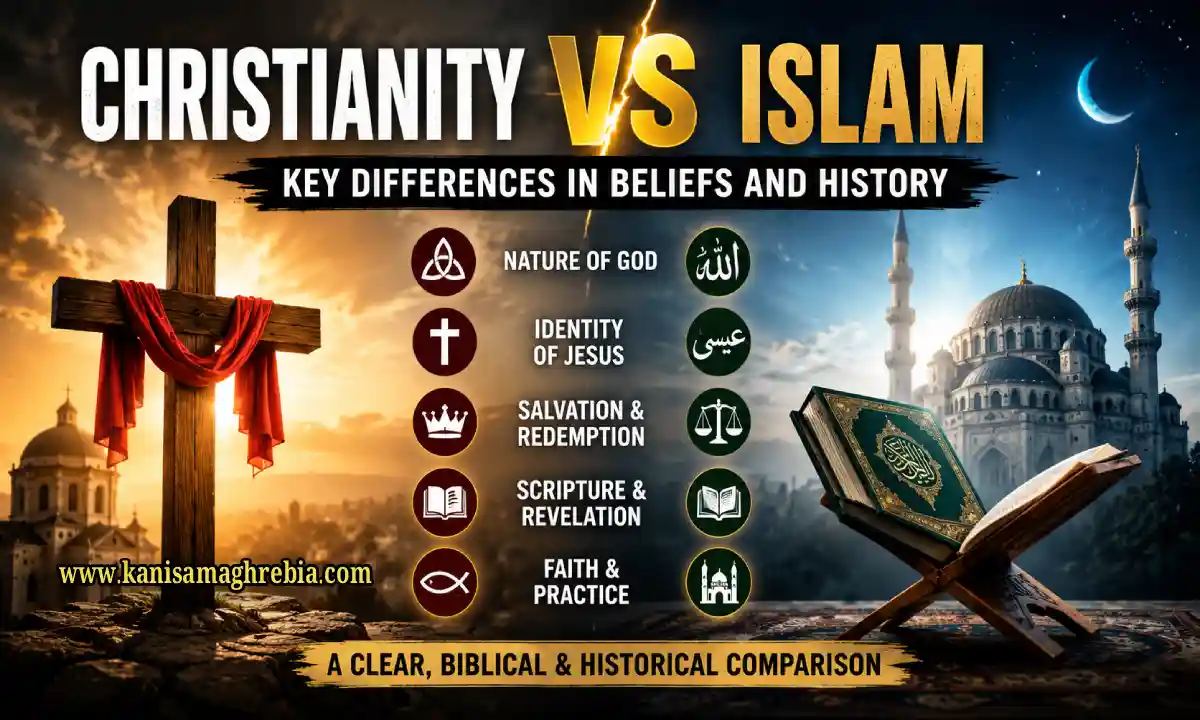
What is the fundamental difference between Christianity and Islam? The main difference between Christianity and Islam rests on the nature of God, the identity of Jesus Christ, and the method of human salvation. Christianity teaches that God is Triune (one essence in three persons), that Jesus is the incarnate Son of God who died on the cross to pay the penalty for human sin, and that salvation is a free gift of grace. Islam teaches strict, indivisible monotheism (Tawhid), reveres Jesus only as a human prophet, denies his crucifixion, and asserts that salvation is achieved through God’s mercy weighed against a person’s faith and righteous deeds.
This direct answer merely scratches the surface. To truly understand these differences, we must unpack the theological architecture of both worldviews.
The Nature of God: The Holy Trinity vs Strict Tawhid
There is perhaps no greater theological battleground between Christianity and Islam than the nature of God Himself. How we define the Creator dictates every subsequent doctrine, from the nature of revelation to the mechanics of salvation.
The Christian View of One God in Three Persons
Christianity is unequivocally monotheistic. “Hear, O Israel: The Lord our God, the Lord is one” (Deuteronomy 6:4). Yet, through the progressive revelation of Scripture, culminating in the incarnation of Christ, God has revealed His nature as Triune: one divine essence eternally existing in three distinct co-equal, co-eternal persons the Father, the Son, and the Holy Spirit.
This is not a mathematical error, nor is it the worship of three gods (tritheism), a heresy the Church has vehemently rejected since its inception. Instead, it is the profound mystery of a relational God. Consider this deeply: if God is eternally in love, as 1 John 4:8 declares, who did He love before the foundation of the world? Love requires an object. If God were a solitary, absolute monad, love would merely be an attribute He acquired upon creating beings to love. But because God is Triune, there has been an eternal, perfect exchange of love within the Godhead. The Father loves the Son, the Son loves the Father, in the unity of the Holy Spirit. God does not need us to experience love; He created us out of the overflow of the perfect love that already existed within His nature.
The Islamic View of Absolute Oneness (Tawhid)
In stark contrast, Islam demands adherence to Tawhid, the doctrine of absolute, indivisible, non-relational oneness. Surah 112 of the Quran summarizes this elegantly: “Say, ‘He is Allah, [who is] One, Allah, the Eternal Refuge. He neither begets nor is born, nor is there to Him any equivalent.'”
From the Islamic perspective, the Christian doctrine of the Trinity is not just confusing; it is the ultimate, unforgivable sin of Shirk associating partners with God. The Islamic worldview looks at the Christian claim and sees a theological contamination, a compromise of God’s supreme majesty. However, from a Christian perspective, restricting God to a mathematical singularity limits His relational capacity. By demanding that God fit neatly into the confines of human arithmetic by insisting that one plus one plus one must equal three, rather than one times one times one equals one the strict Islamic view constructs an intellectual prison for the Divine. It creates a God who is ultimately transcendent and powerful, but fundamentally isolated.
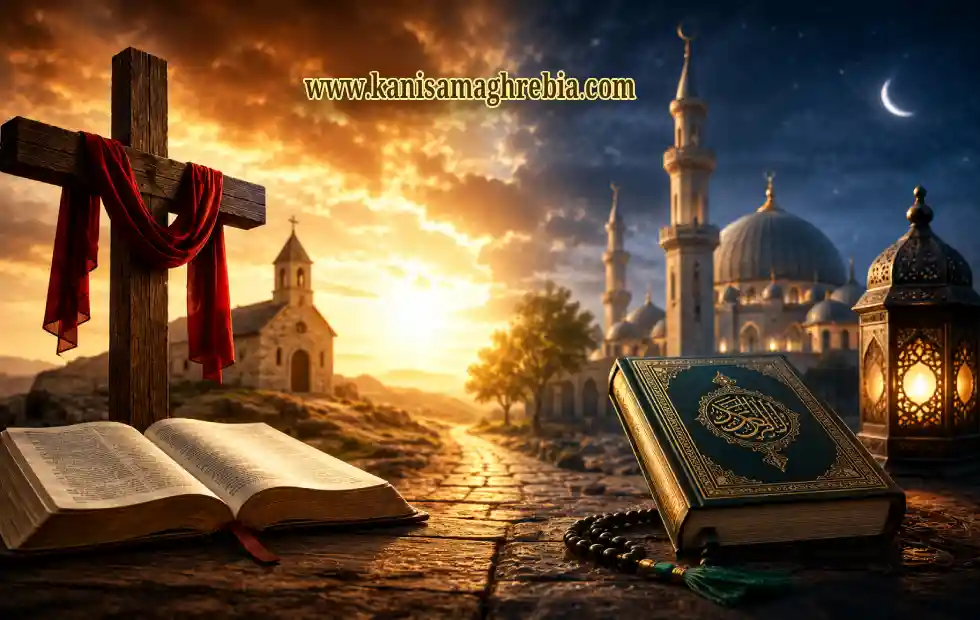
The Identity of Christ: The Son of God vs A Prophet
If the nature of God is the overarching canopy of our theological disagreement, the identity of Jesus of Nazareth is the very ground upon which we stand and fight. Who is this man who cleaved history in two?
Jesus (Yeshua) as the Incarnate Word
Christianity rises and falls on the identity of Jesus Christ (Yeshua). The biblical witness is unwavering: Jesus is the eternal Logos (Word), the second person of the Trinity who took on human flesh. The early Church Councils, such as Chalcedon in 451 AD, meticulously defined this as the hypostatic union Jesus is 100% God and 100% man, two distinct natures perfectly united in one person without confusion, change, division, or separation.
Why did this happen? How did the Infinite step into the finite? It happened because humanity, trapped in the rebellion of sin, could not reach God. Therefore, God, in His incomprehensible humility, reached down to us. Jesus did not merely come to point the way to God; He declared Himself to be the Way, the Truth, and the Life (John 14:6). He claimed the divine name for Himself (John 8:58), accepted worship (John 20:28), and forgave sins a prerogative belonging to God alone (Mark 2:5-7).
Isa Ibn Maryam in the Islamic Tradition
Islam, conversely, reveres Jesus (known as Isa al-Masih) as a mighty prophet and messenger of God, but strictly denies His divinity and His sonship. The Quran affirms His virgin birth, His ability to perform miracles (even giving life to clay birds, a story borrowed from second-century apocryphal infancy gospels), and His bodily ascension to heaven.
Yet, for all this reverence, the Islamic Jesus is stripped of His salvific power. The Quran repeatedly warns against calling Jesus the Son of God (Surah 9:30). Here lies a profound, frustrating contradiction that the intellectually honest seeker must confront: How can Islam accept the miraculous, supernatural elements of Christ’s life, yet violently reject the very claims that Christ made about Himself? To embrace the miracles of Jesus while dismissing His declarations of divine authority is to selectively edit history to fit a theological presupposition.
Sin and Salvation: Grace and the Cross vs Human Effort
The divide between Christianity and Islam widens exponentially when we address the human condition and how it is remedied. How is a flawed human being reconciled to a perfectly holy God?
The Fall of Man and the Need for a Savior
Christianity teaches that the human race is fundamentally broken by sin. Through the rebellion in Eden, human nature was corrupted, a concept often termed Original Sin or ancestral depravity. The chasm between a perfectly holy, infinitely just God and sinful humanity is not a gap that can be bridged by human effort. Isaiah 64:6 reminds us that even our most “righteous acts are like filthy rags” when held against the blinding standard of God’s perfection.
Therefore, salvation cannot be earned; it must be gifted. This is the heart of the Christian Gospel. God’s justice demands a penalty for sin, but God’s love provides the substitute. Jesus Christ lived the perfect life we could not live and died the death that we deserved. Salvation in Christianity is received through faith alone, by grace alone, in Christ alone (Ephesians 2:8-9). Good works are not the root of salvation; they are the inevitable fruit of a transformed heart.
The Islamic View of Sin and the Scales of Deeds
Islam rejects the concept of Original Sin. Every child is born pure, in a state of Fitrah (natural disposition to worship God). Sin is not an inherited condition but an action, a failure to obey God’s law due to human weakness and forgetfulness. Because human nature is not fundamentally corrupted, humanity does not need a divine Savior; we simply need guidance.
Salvation in Islam is achieved by submitting to Allah’s will, following His laws, and performing good deeds. On the Day of Judgment, a person’s deeds will be weighed on the Mizan (scales). If the good outweighs the bad, and if Allah extends His mercy, paradise is granted (Surah 23:102-103). Consequently, a Muslim lives in a perpetual state of tension between fear and hope, never possessing the absolute assurance of salvation that a Christian enjoys through the finished work of Christ.
The Crucifixion: History vs Denial
To speak of Christian salvation is to speak of the Cross. Historically, the crucifixion of Jesus of Nazareth under Pontius Pilate is one of the most firmly established facts of ancient history. We do not rely solely on the Gospels. Roman historians like Tacitus, Jewish historians like Josephus, and Greek satirists like Lucian of Samosata all confirm that Jesus was executed by crucifixion.
Yet, six hundred years after the event, Islam introduced a staggering historical revision. Surah 4:157 claims, “And [for] their saying, ‘Indeed, we have killed the Messiah, Jesus, the son of Mary, the messenger of Allah.’ And they did not kill him, nor did they crucify him; but [another] was made to resemble him to them.”
This denial is a masterpiece of theological convenience, but it is a historical disaster. Methodically, we must ask:
- Who was placed on the cross instead of Jesus? (Islamic traditions vary wildly some say Judas, some say a volunteer).
- Why would God deceive the entire world, including Jesus’ own mother and closest disciples, making them believe He died?
- How does this align with the justice of God, to start the world’s largest religion (Christianity) based on a divine illusion?
To deny the crucifixion is not merely to disagree on a theological point; it is to dismiss the overwhelming consensus of first-century history. The Christian responds to this denial not with arrogance, but with the sobering reality of an empty tomb. The Cross is the undeniable anchor of human history, the precise moment where God’s infinite justice and boundless mercy kissed.
Holy Texts: The Bible vs The Quran
Our understanding of God, Christ, and salvation is drawn from our respective holy texts. Here, too, the definitions of revelation and authority are irreconcilable.
Divine Inspiration and the Preservation of the Word
Christians believe the Bible is the inspired, infallible Word of God. The doctrine of inspiration is dual-authored: the Holy Spirit guided human authors to write exactly what God intended, utilizing their unique personalities, cultural contexts, and literary styles. The Bible is a library of 66 books written over 1,500 years by more than 40 authors on three continents, yet it possesses a singular, unified narrative pointing relentlessly to Jesus Christ.
When Muslims approach the Bible, they do so with the presupposition of Tahrif (corruption). Because the biblical text directly contradicts the Quran regarding the divinity of Christ and the crucifixion, Islamic theology necessitates that the original Gospel (Injil) and Torah (Tawrat) were altered by Jews and Christians over time.
But this accusation crumbles under logical and historical scrutiny. When did this corruption happen? If it happened before Muhammad, why does the Quran command Christians to judge by the Gospel they possess (Surah 5:47)? If it happened after Muhammad, how did Christians manage to gather thousands of manuscripts scattered across Europe, Africa, and Asia, alter them all uniformly without leaving a trace of the “original” Islamic version, and do so without the warring factions of the Church exposing the conspiracy? The discovery of the Dead Sea Scrolls and thousands of early Greek papyri proves beyond a shadow of a doubt that the biblical text has been preserved with astonishing fidelity.
The Quranic View of Dictation
The Islamic view of revelation is entirely different. The Quran is believed to be the exact, literal, uncreated speech of Allah, dictated word-for-word to Muhammad by the angel Gabriel over 23 years. There is no human authorship involved; Muhammad was merely a passive vessel. The Quran exists perfectly on a guarded tablet in heaven. Therefore, any critique of the Quranic text, its historical compilation under Caliph Uthman, or its chronological arrangement is treated as an attack on God Himself.
Core Practices and Worship
The theological divergence naturally dictates the daily lives and practices of believers in both faiths.
Sacraments and Relationship vs The Five Pillars
How do the practices of Christianity and Islam differ? Christian worship is fundamentally relational, focusing on inward transformation and the indwelling of the Holy Spirit, centered around sacraments like Baptism and Communion. Islamic worship is highly structured, focusing on outward submission and communal obedience through the framework of the Five Pillars.
In Christianity, the believer enters into a New Covenant. The focus is not on adhering to a rigid set of external laws, but on the internal transformation of the heart by the Holy Spirit (Ezekiel 36:26). Practices like Baptism (the public declaration of dying to sin and rising in Christ) and the Eucharist (the remembrance of Christ’s sacrifice) are deeply relational sacraments. Prayer is an intimate, continuous conversation with a Heavenly Father, not constrained by language, posture, or a specific geographic direction.
Islam operates on the Five Pillars: Shahada (declaration of faith), Salah (five daily ritual prayers facing Mecca), Zakat (almsgiving), Sawm (fasting during Ramadan), and Hajj (pilgrimage to Mecca). These are rigorous, beautiful in their communal discipline, and deeply physically involved. Yet, they represent a theology of law. The relationship is between a Master and a servant, not a Father and an adopted child. The physical orientation toward a geographical location (Mecca) during prayer emphasizes the earthly, territorial nature of Islamic practice, contrasting sharply with the Christian belief that the true temple of God is now the human heart.
A Brief Historical Intersection
The history of interaction between Christianity and Islam is complex, marked by periods of cultural exchange and centuries of theological and military conflict. Islam emerged in the 7th century in the Arabian Peninsula, a region already familiar with various sects of Christianity. As the Islamic empire expanded rapidly across the Middle East and North Africa, it swallowed historically Christian lands Syria, Egypt, and eventually the Byzantine capital, Constantinople.
Early Christian theologians, like John of Damascus in the 8th century, were among the first to systematically respond to Islam. John, writing from within the Umayyad Caliphate, categorized Islam not as a new world religion, but as a Christian heresy an offshoot that had drastically misunderstood the nature of the Trinity and the Incarnation.
Throughout the centuries, this theological clash manifested in the Crusades, the Ottoman expansions, and modern geopolitical conflicts. Yet, beneath the political violence, the theological arguments have remained remarkably static. The Islamic critique still centers on defending Tawhid against the Trinity, and the Christian defense still centers on the historical reality of the Cross and the reliability of the Bible. History shows us that when these two faiths meet, they do not synthesize; they collide. And it is in the sparks of that collision that the truth must be rigorously sought.
Frequently Asked Questions About Christianity vs Islam
Do Christians and Muslims worship the same God?
While both religions claim to worship the one, uncreated Creator of the universe who spoke to Abraham, their definitions of His nature are incompatible. Christians worship a Triune God who became incarnate in Jesus Christ; Muslims worship a strictly singular God (Allah) and completely reject the Trinity and the Incarnation. Because the fundamental identity and character of the deity are defined so differently, theologically, they do not worship the same God.
What is the difference between Jesus in Christianity and Isa in Islam?
In Christianity, Jesus is the divine Son of God, the second person of the Trinity, the Savior of the world who died for human sins and was resurrected. In Islam, Isa is a highly respected human prophet, born of a virgin, who performed miracles by God’s permission, but he is not divine, he is not the Son of God, and he was never crucified.
Does Islam believe in the Christian Bible?
No. While Islam claims to revere the original Torah (Tawrat), Psalms (Zabur), and Gospel (Injil) as previous revelations, Muslims believe the current Jewish and Christian Bibles have been corrupted, altered, and translated inaccurately over time (the doctrine of Tahrif). They rely solely on the Quran as the final, uncorrupted revelation.
How does a person get to heaven in Christianity vs Islam?
In Christianity, heaven (salvation) is a free gift received through faith in the sacrificial death and resurrection of Jesus Christ. It cannot be earned by good deeds. In Islam, a person reaches paradise by submitting to Allah, following Islamic law, and hoping that their good deeds outweigh their bad deeds on the Day of Judgment, ultimately relying on Allah’s mercy.
Why do Christians believe Jesus had to die?
Christians believe God is perfectly just and perfectly loving. His justice demands that the penalty for sin (death) must be paid. His love provides a substitute. Jesus, being sinless, willingly took the punishment of humanity upon Himself on the cross, satisfying God’s justice so that humanity could be freely forgiven.
Did the Prophet Muhammad exist in the Bible?
Muslims often claim that Muhammad is prophesied in the Bible, most notably arguing that the “Helper” or “Comforter” (Paraclete) promised by Jesus in John 14 is Muhammad. Christians adamantly reject this, pointing out that Jesus explicitly identifies the Comforter as the Holy Spirit (John 14:26), whom Jesus says will dwell inside the believers forever, a description that cannot apply to a human prophet.
Conclusion
To study the beliefs, practices, and histories of Christianity and Islam is to stand at the crossroads of human civilization. The differences between these two worldviews are not superficial misunderstandings; they are foundational, irreconcilable claims about the nature of reality, the identity of God, and the destiny of the human soul.
If the Quran is right, the Christian is engaged in the worst form of blasphemy. If the Bible is right, the Muslim is engaged in the worst form of blasphemy and tragically separated from the saving grace of the cross and the boundless love of a Heavenly Father. In this dialogue, truth matters. History matters. The empty tomb matters. Let us move past the polite fictions of modern relativism and engage one another with intellectual honesty, vigorous debate, and, above all, the transformative, radical love that Christ demonstrated when He stretched out His arms on the wood of the cross for the sins of the whole world.