





Introduction: How Does Islam Deal with Non-Muslims?
We live in an age that desperately craves the comfort of uniformity, an era where the sharp, defining edges of distinct truth claims are continuously sanded down in the name of social harmony. When we ask profound, worldview-defining questions, society often hands us an intellectual anesthetic, a polite assurance that all spiritual paths ultimately lead to the exact same destination, operating by the exact same rules. Yet, for anyone who has ever wrestled in the quiet hours of the night with the enduring texts of world religions, this modern platitude is not merely insufficient; it is deeply dishonest. As Christians called to love our neighbors, we cannot love someone we refuse to understand. We must push past the cultural pressure of intellectual isolation, the modern reluctance to examine hard texts, and dare to ask: How do differing worldviews actually view the “other”? Specifically, how does Islam deal with non-Muslims?
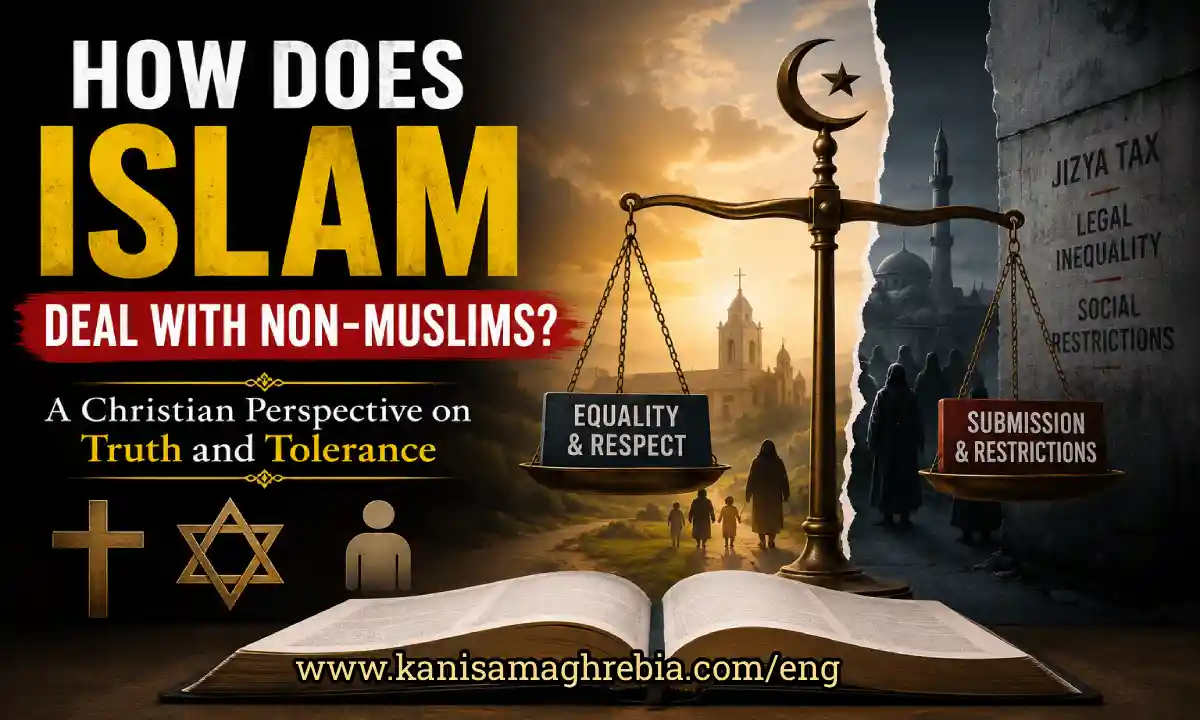
Short answer: Islam deals with non-Muslims by categorizing them into distinct legal and theological groups, primarily the “People of the Book” (Christians and Jews) and polytheists or unbelievers. According to classical Islamic jurisprudence (Sharia) and the later Medinan chapters of the Quran, non-Muslims living under Islamic rule are not granted equal sociopolitical status. Instead, Christians and Jews are offered the status of dhimmi, a protected but legally subordinated class conditional upon their submission to Islamic authority, the payment of a specific tax called the jizya, and adherence to strict social restrictions. Polytheists, historically, were given the choice of conversion or the sword.
To understand this deeply, we must bypass modern political commentary and look methodically at the theological architecture of Islam. We must ask: Where does this teaching originate? How is it implemented? Who exactly does it affect? Why is it structured this way? And when did these doctrines solidify? Only by mapping this landscape can we meaningfully contrast it with the radical, self-giving love of Jesus Christ.
The Burden of Truth: Why We Must Ask the Difficult Questions
Every generation suffers from a unique set of blind spots, and ours is the assumption that theology does not possess real-world consequences. We often project a post-Enlightenment, Western view of religious liberty onto ancient texts and foreign worldviews, assuming that every religion views faith as a purely private, internal matter. This is a profound category error.
To ask how Islam deals with non-Muslims is not an exercise in provocation; it is a necessity for truth-seekers. There is a righteous frustration that arises when one watches sincere people both Christian and Muslim flounder in dialogue because they are speaking past one another, utilizing the same vocabulary but relying on entirely different dictionaries. We use words like “peace,” “tolerance,” and “justice,” assuming universal definitions. But in Islamic theology, “peace” (salam) is inextricably linked to “submission” (islam). True peace, historically and textually, is achieved when the world is brought under the submission of Allah’s divine law.
If we are to care for our Muslim neighbors pastorally, and if we are to equip Christians with a resilient faith, we cannot rely on media soundbites. We must sequentially dismantle the confusion by looking at the primary sources: the Quran, the Hadith (the traditions and sayings of Muhammad), and the Sirah (his biographical literature).
The Scriptural Blueprint: What the Quran Actually Commands
How does a devout Muslim know how to interact with those outside the faith? The answer is found in the Quran, but the Quranic approach to non-Muslims is not monolithic. It represents a progressive revelation that shifts dramatically depending on the historical circumstances of Muhammad’s life. To understand how Islam treats the outsider, we must first understand when the specific commands were given. Islamic scholars divide the Quran into two distinct periods: the Meccan period and the Medinan period.
The Early Years: The Era of Peaceful Persuasion (Mecca)
During the first thirteen years of Muhammad’s ministry in Mecca (approx. 610–622 AD), he was a marginalized preacher leading a small, powerless minority. The revelations from this period are largely spiritual, focusing on the oneness of God, the impending judgment, and the necessity of righteous living.
When interacting with non-Muslims during this time, the Meccan surahs (chapters) emphasize patience, persuasion, and a “live and let live” philosophy. It is from this period that Western commentators often quote the famous verse:
“Let there be no compulsion in religion…” (Surah 2:256).
Another frequently cited verse from this era is Surah 109:6, where Muhammad is told to say to the unbelievers:
“For you is your religion, and for me is my religion.”
If the Quran ended here, the Islamic approach to non-Muslims would largely mirror modern concepts of pluralism. However, these texts cannot be read in isolation. They must be understood through the lens of what followed.
The Law of Abrogation: When Context Commands the Sword (Medina)
In 622 AD, Muhammad migrated to Medina (the Hijrah). Here, his status radically shifted from a persecuted preacher to a powerful political and military statesman. As the socio-political reality of the Muslim community changed, so did the tone and content of the Quranic revelations.
To resolve contradictions between the peaceful Meccan verses and the militant Medinan verses, Islamic jurisprudence relies on a vital theological principle called Naskh, or the Law of Abrogation. Derived from Surah 2:106, this doctrine dictates that when two verses contradict, the later revelation chronologically cancels out, or abrogates, the earlier one.
This brings us to Surah 9 (At-Tawbah), chronologically one of the very last chapters revealed. It is famously the only chapter in the Quran that does not begin with the invocation of Allah’s mercy. Surah 9 contains the “Verse of the Sword” (Surah 9:5), which commands:
“And when the sacred months have passed, then kill the polytheists wherever you find them and capture them and besiege them and sit in wait for them at every place of ambush.”
According to classical Islamic exegesis (Tafsir), this verse and others like it in Surah 9 abrogated dozens of earlier verses of peaceful persuasion. The final, enduring command of the Quran regarding pagan non-Muslims was not peaceful coexistence, but subjugation or conversion.
The “People of the Book”: Privilege or Subjugation?
Where does this leave Christians and Jews? Are we considered polytheists destined for the sword? The Quran makes a distinct separation here.
Who Are the Ahl al-Kitab?
Christians and Jews are granted a special title: Ahl al-Kitab, or the “People of the Book.” Islam acknowledges that Christians and Jews received legitimate, albeit earlier, revelations from God (the Torah to Moses, the Gospel to Jesus). Because of this shared monotheistic heritage, Christians and Jews are not strictly subjected to the binary choice of conversion or death.
However, this is not an endorsement of Christian theology. The Quran explicitly condemns the core tenets of the Christian faith. It vigorously denies the Trinity, explicitly condemning those who say “God is three” (Surah 5:73). It denies the deity of Jesus Christ, reducing Him to a mere prophet (Surah 5:75). Most crucially, it flatly denies the historical reality of the crucifixion, stating that Jesus was not killed, but it was merely made to appear so (Surah 4:157).
Therefore, while Christians are afforded a higher status than pagans, we are still viewed as people who have corrupted God’s original message. How, then, does an Islamic state deal with a corrupted but tolerated minority?
The Dhimmi Status: Protection at the Price of Humiliation
When Islamic armies expanded rapidly across the Middle East, North Africa, and into Europe, they conquered lands heavily populated by Christians and Jews. The legal framework designed to manage these non-Muslim populations is called the Dhimma, and those under it are known as dhimmis (protected persons).
A dhimmi is a non-Muslim living in an Islamic state. The state offers them protection of their life and property, and the right to practice their religion privately. In exchange, the dhimmi must submit to Islamic political supremacy.
But what did this submission look like in practice? Historically, it was codified in documents like the Pact of Umar, a foundational treaty that outlined the conditions of dhimmitude. While enforcement varied wildly depending on the era and the temperaments of local rulers, the systematic legal requirements often included:
- Architectural subjugation: Dhimmis could not build new churches or synagogues, nor could they repair old ones that fell into ruin. Their places of worship could not be taller than local mosques.
- Public invisibility: They could not ring church bells, display crosses publicly, or read their scriptures loud enough for Muslims to hear.
- Social deference: They were often required to wear distinctive clothing (the historical precursor to the yellow star) to identify themselves as non-Muslims. They had to yield the center of the road to Muslims.
- Legal inferiority: A dhimmi could not testify against a Muslim in an Islamic court, making them incredibly vulnerable to abuse and exploitation.
This system was not designed merely for social order; it was designed as a theological statement. It is a system built on the premise that truth must possess political supremacy, and error must be visibly subjugated. It is a gilded cage offering physical life, but systematically stripping away social dignity to incentivize conversion to Islam.
The Jizya: A Theological Tax
The cornerstone of the dhimmi contract is the jizya. The jizya is a per-capita yearly tax levied on non-Muslim subjects. Its foundation is explicitly stated in Surah 9:29:
“Fight those who do not believe in Allah or in the Last Day and who do not consider unlawful what Allah and His Messenger have made unlawful and who do not adopt the religion of truth from those who were given the Scripture – [fight] until they give the jizya willingly while they are humbled.”
Notice the specific wording: “while they are humbled” (or in some translations, “brought low”). The jizya was not merely an administrative tax comparable to modern income tax. It was designed as a penalty for refusing to accept Islam. Classical Islamic jurists detailed how the tax should be collected, often requiring the dhimmi to pay it in person, sometimes involving physical gestures of subordination (like a tap on the neck) to underscore their inferior status.
Why was this necessary? Because in classical Islamic thought, the world belongs to Allah, and those who reject Allah’s final prophet have forfeited their inherent right to the earth’s resources. The jizya is effectively a ransom paid by the non-Muslim for permission to keep their life and beliefs.
The Geopolitics of Belief: Dar al-Islam and Dar al-Harb
To fully grasp how Islam views the non-Muslim world, we must zoom out from individual taxation to global geopolitics. Classical Islamic jurisprudence divides the globe into two distinct spheres.
The House of Islam and the House of War
The first is Dar al-Islam (The House of Islam). This encompasses any territory where Islamic law (Sharia) is the law of the land and where Muslims hold political dominance. Within Dar al-Islam, peace exists because submission to Allah’s law has been established.
The second is Dar al-Harb (The House of War). This encompasses all territories not currently under Islamic rule. It is called the House of War because, theoretically, it is in a state of rebellion against God’s law. According to classical jurisprudence, it is the eventual duty of the Muslim community (the Ummah) to bring Dar al-Harb into Dar al-Islam, whether through proselytization (Dawah) or, historically, military conquest (Jihad).
This geopolitical binary underscores a critical truth: Islam is not merely a personal set of spiritual beliefs about the afterlife. It is a comprehensive sociopolitical, legal, and economic system designed to govern the entirety of human existence. When a religion views itself as a political state, the “non-believer” inevitably transforms into a “second-class citizen” or a potential enemy of the state.
Apostasy and the Boundaries of Religious Freedom
Perhaps the starkest evidence of how Islam deals with the “other” is found in how it treats those who choose to become the other. If a Christian or Jew wishes to convert to Islam, they are celebrated. But what if a Muslim decides that Jesus Christ is the true Son of God and wishes to leave Islam?
In all four major schools of Sunni Islamic jurisprudence, as well as Shia jurisprudence, the penalty for apostasy (Riddah) by an adult male of sound mind is death. Muhammad’s command, recorded in Sahih al-Bukhari, is explicit: “Whoever changes his Islamic religion, then kill him.”
While many modern, Westernized Muslims are deeply uncomfortable with this law and seek to reinterpret or spiritualize it, the classical and historical consensus is unbroken. Freedom of religion, in the classical Islamic paradigm, is a one-way street. You are free to enter the House of Islam, but you are forbidden, on pain of death, from leaving it.
Anticipating the Skeptic: What About the Crusades?
Whenever a Christian points out the historical and textual realities of Islamic subjugation, a secular or skeptical voice will inevitably raise a familiar objection: “What about the Crusades? What about the Inquisition? Didn’t Christians deal with non-Christians with the sword?”
This is a fair question that deserves a methodical, intellectually honest answer. Yes, history is replete with moments where individuals claiming the name of Christ utilized horrific violence, coercion, and subjugation against non-Christians (and against other Christians). The Crusades, the Inquisition, and anti-Semitic pogroms are deeply tragic, sinful stains on Western history.
However, there is a fundamental, worldview-shattering difference.
When a Christian picks up a sword to forcibly convert or subjugate a non-believer, they must absolutely violate the explicit teachings, life, and commands of Jesus Christ to do so. They have to ignore Christ’s command to “love your enemies and pray for those who persecute you” (Matthew 5:44). They have to ignore Christ’s rebuke of Peter for drawing a sword in the Garden of Gethsemane: “Put your sword back in its place, for all who draw the sword will die by the sword” (Matthew 26:52).
Conversely, when Islamic armies swept out of the Arabian Peninsula in the 7th and 8th centuries, conquering, subjugating, and imposing the jizya on non-Muslims, they were not violating the teachings of their founder. They were precisely obeying them. They were following the exact example set by Muhammad in Medina.
The Christian who conquers in the name of Christ is an anomaly to his own Scriptures. The Muslim who conquers in the name of Allah is living in faithful obedience to the Medinan model. The difference is not found in the flawed nature of human beings; we are all deeply fallen. The difference is found in the foundational DNA of the religions themselves.
A Kingdom Not of This World: The Christian Response
How, then, does Biblical Christianity contrast with this? If we reject the dhimmi system, the jizya, and the execution of apostates, what is the Christian blueprint for dealing with those outside the faith?
It is here that the brilliance, the beauty, and the staggering grace of the Gospel shine the brightest.
The Imago Dei: Dignity Inherent, Not Earned
The Christian view of the non-Christian begins not with a legal classification, but with Genesis 1:27: “So God created mankind in his own image, in the image of God he created them; male and female he created them.”
The doctrine of the Imago Dei (Image of God) is the bedrock of Western human rights. It means that every human being whether they are a devout Christian, a devout Muslim, an atheist, or an idolater possesses inherent, unshakeable dignity and worth. Their value is not conditional upon their theological submission to our worldview.
In Islam, dignity and rights are largely tethered to one’s submission to Allah. In Christianity, dignity is tethered to one’s creation by God. This means a Christian can look at a non-Christian and say, “I vehemently disagree with your theology, I believe you are spiritually lost, but you are fearfully and wonderfully made, and I will defend your basic human dignity with my life.”
The Cross vs. The Sword: How Christ Dealt with the “Other”
How did Jesus Christ deal with those who opposed Him? When Pilate interrogated Jesus, asking if He was a king attempting to usurp Rome, Jesus gave an answer that forever severed the Christian faith from sociopolitical domination:
“My kingdom is not of this world. If it were, my servants would fight to prevent my arrest by the Jewish leaders. But now my kingdom is from another place” (John 18:36).
The Kingdom of God does not expand by territory, tax, or the sword. It expands through the preaching of the Word and the regeneration of the heart by the Holy Spirit.
Furthermore, the Christian Gospel is fundamentally incompatible with the concept of the jizya. In the Islamic system, the non-Muslim pays a tax to secure their life and cover their rebellion against God. But the core of Christianity is that we were all rebels against God. We were all in the House of War. As the Apostle Paul writes, “While we were still sinners, Christ died for us” (Romans 5:8).
We could not pay the ransom for our own rebellion. So, God Himself stepped out of eternity, took on human flesh, and paid the ransom for us on the cross. We do not demand a tax from unbelievers because our King paid the ultimate tax with His own blood for the unbelievers.
Because of this, true Christian theology demands religious liberty. Faith that is coerced by a state, incentivized by a tax, or maintained by the threat of execution is not faith at all; it is mere compliance. God desires the genuine, loving devotion of the human heart, and love must be freely chosen.
Conclusion: An Earnest Plea for Clarity and Love
How does Islam deal with non-Muslims? Historically, legally, and textually, it deals with them through a framework of superiority and subjugation. It offers life, but demands humiliation in return. It creates a sociopolitical environment where the “other” is constantly reminded of their second-class status, urging them toward submission.
But our response as Christians must not be one of reciprocal hostility. We are not called to hate Muslims; we are commanded to love them profoundly. True love, however, rejoices in the truth (1 Corinthians 13:6). We cannot love our Muslim neighbors by pretending their scriptures teach things they do not. We cannot effectively share the Gospel if we are ignorant of the heavy theological structures like dhimmitude and the fear of apostasy laws that bind them.
Let us stand firm in the historical and biblical truth. Let us reject intellectual isolation and possess the courage to contrast the law of Medina with the grace of Calvary. For when the world sees the stark contrast between a religion that demands a tax for your life and a Savior who gives His life to pay your debt, the unparalleled beauty of Jesus Christ becomes impossible to ignore.
Frequently Asked Questions: How Does Islam Deal with Non-Muslims?
What is a Dhimmi in Islam?
A dhimmi is a non-Muslim (typically a Christian or Jew, known as the “People of the Book”) living in a state governed by Islamic law. They are granted protection of life and property but are relegated to a subordinate legal and social status, required to pay a specific tax and adhere to restrictions on their religious practices.
What is the Jizya tax?
The jizya is a per-capita yearly tax historically levied by Islamic states on non-Muslim subjects permanently residing in Muslim lands. Rooted in Surah 9:29 of the Quran, it functions as a fee for protection, an exemption from military service, and a symbol of their submission to Islamic authority.
Does the Quran say “there is no compulsion in religion”?
Yes, this phrase is found in Surah 2:256, which was revealed during the earlier, more peaceful period of Muhammad’s life. However, classical Islamic scholars teach that this verse was abrogated (overruled) by later, more militant verses such as the Verse of the Sword in Surah 9 which command fighting against unbelievers until they submit.
How does Islam view Christians and Jews compared to atheists?
Islam categorizes Christians and Jews as Ahl al-Kitab (People of the Book). Because they possess earlier, albeit viewed as corrupted, revelations from God, they are permitted to live under Islamic rule as dhimmis. Atheists and polytheists, historically, were not afforded this protection and were often given the choice of conversion or death.
What is the penalty for leaving Islam?
According to the consensus of all major classical schools of Islamic jurisprudence (both Sunni and Shia), based on the Hadith, the penalty for apostasy (leaving the Islamic faith) by a sane adult male is execution. While many modern Muslim-majority countries do not enforce this legally, the theological doctrine remains in place.
How is the Christian view of non-believers different from Islam?
Christianity views all people, regardless of their faith, as created in the Imago Dei (Image of God), thereby possessing inherent dignity and worth. Christians are commanded by Jesus to love their enemies and pray for them. Christ’s kingdom is spiritual, not geopolitical, so Christianity advocates for genuine religious liberty rather than sociopolitical subjugation.