











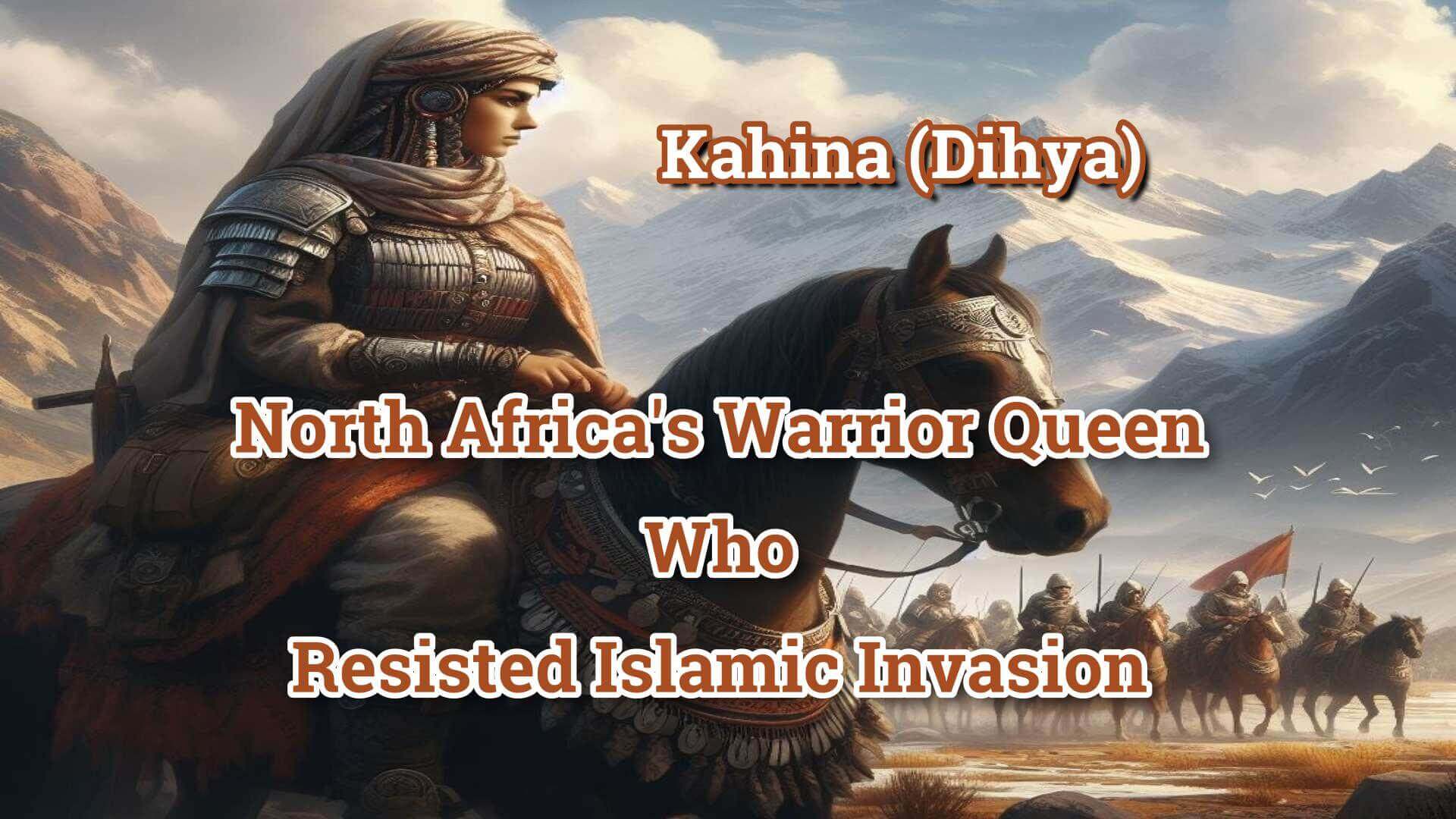
This is the script for the video about Kahina.
Grace and peace of Jesus Christ with you all.
Introduction:
Welcome to our new video About a Berber woman who resisted Islamic invasion in north Africa. I apologize for the absence for reasons beyond my control, but I thank God that I am back, and I missed you.
Muslims always sing that the countries that were conquered welcomed the Muslims and did not resist them, but this is not true, as history records that it was intense resistance from the Berbers of North Africa and led by a woman. Let us learn about the story of the woman who resisted the Islamic conquest.
Before we start , Please, hit the like button, share it with friends, and subscribe to stay tuned for more videos.
The History of Kahina:
Once upon a time, in the vast landscapes of North Africa, there lived a formidable and resilient woman named Kahina, also known as Dihya. Her story is one of resistance, courage, and the clash of civilizations during a tumultuous period in history.
Kahina was born in the early 7th century in North Africa. A member of the Berber people, she grew up in a society with its own rich culture and traditions. The Berbers were the indigenous people of North Africa, and their lands stretched from present-day Morocco to Tunisia. Kahina’s early life was marked by the beauty of the Atlas Mountains and the endless stretches of the Sahara Desert.
The 7th century was a time of great change and upheaval in the region. The Arabian Peninsula, home to the followers of Prophet Muhammad, had witnessed the rise of Islam. The message of Islam began to spread rapidly, and the Arab armies embarked on a series of conquests to bring the newly-formed Islamic state under a single banner.
The Islamic expansion reached the shores of North Africa, bringing with it a different language, culture, and religion. The Berber people, proud of their own identity and autonomy, were not eager to embrace this foreign influence. The clash between the Berber and Arab worlds was inevitable, and at the center of this conflict stood Kahina.
Kahina emerged as a charismatic and powerful leader among the Berbers. She was known for her intelligence, strategic acumen, and deep connection with the land. As the Arab armies advanced into North Africa, Kahina rallied her people to resist the invaders. Her vision was to preserve the Berber way of life and prevent the subjugation of her people under the rule of the expanding Islamic state.
The first major conflict occurred in the 680s when Islamic forces, led by the Umayyad general Uqba ibn Nafi, clashed with Kahina’s Berber warriors. The Battle of Tahuda was a fierce confrontation that saw Kahina employing guerrilla warfare tactics, utilizing the challenging terrain to her advantage. Despite facing overwhelming odds, Kahina’s forces inflicted significant casualties on the Islamic invaders, forcing them to retreat temporarily.
Kahina’s story is the oversimplification of the conflict as a religious war between Muslims and non-Muslims. In reality, the struggle was more complex, rooted in the clash of different cultural identities, political ambitions, and the desire for territorial control. The Berber resistance was solely a rejection of Islam and a fight for autonomy and the preservation of their distinct way of life.
As the conflict continued, Kahina faced internal challenges as well. Some Berber tribes were more willing to collaborate with the Arab forces in exchange for favorable terms. This internal division weakened the overall resistance against the islamic invaders. Kahina, however, remained steadfast in her commitment to the cause, attempting to unite the Berber tribes against the common threat.
The second major confrontation took place at the Battle of Meclili in 688. This time, the Arab forces, now led by the Umayyad Caliphate, were determined to crush the Berber resistance once and for all. Kahina’s forces fought valiantly, but the tide turned against them. The Berbers suffered a significant defeat, and Kahina herself was captured.
The fallacy that persists is the notion that Kahina’s resistance was futile and that she was merely a symbol of a lost cause. In reality, Kahina’s efforts had a lasting impact on the region. The Berber resistance delayed the Arab conquest and contributed to the eventual amalgamation of Berber and Arab cultures in North Africa. Kahina’s legacy lived on in the collective memory of the Berber people, symbolizing the spirit of resistance against external forces.
Following her capture, Kahina’s fate remains shrouded in mystery and legend. Some accounts suggest that she converted to Islam, while others claim she took her own life to avoid being paraded through the streets of the victorious Arab conquerors. The uncertainty surrounding her end adds an air of mystique to Kahina’s story, making her a figure of enduring fascination.
In the aftermath of the conflicts, North Africa underwent significant changes. The Berber people, while maintaining their distinct identity, became integral contributors to the Islamic civilization that flourished in the region. The Arab-Berber synthesis led to the formation of a unique cultural tapestry that continues to shape the identity of North Africa to this day.
The fallacy that Kahina’s resistance was solely a Berber-Muslim conflict obscures the nuanced dynamics of the time. It fails to recognize the complexities of identity, culture, and geopolitics that defined the era. Kahina’s story serves as a reminder that history is often more intricate than the simplified narratives that emerge over time.
Conclusion:
In conclusion, the tale of Kahina, the Berber warrior queen, is a captivating chapter in the history of North Africa. Her resistance against the Arab Islamic invasion was a strong rejection of Islam and a courageous stand for the preservation of Berber autonomy. The fallacies surrounding her story highlight the need for a nuanced understanding of historical events, acknowledging the multifaceted factors that shape the course of civilizations. Kahina’s legacy endures as a symbol of resilience, cultural pride, and the enduring quest for freedom in the face of formidable challenges caused by islamic invasions.
This Story expose the lies of Muslims that the islamic invasions was welcomed by nations and they called openings of countries.
Please,hit the like button, share it with friends, and subscribe to stay tuned for more videos.